Monday, December 23, 2013

Why generation Y yuppies are unhappy, by Tim Urban.

Say hi to Lucy.

Lucy is part of Generation Y, the generation born between the late 1970s and the mid 1990s.  She's also part of a yuppie culture that makes up a large portion of Gen Y.  

I have a term for yuppies in the Gen Y age group—I call them Gen Y Protagonists & Special Yuppies, or GYPSYs.  A GYPSY is a unique brand of yuppie, one who thinks they are the main character of a very special story.

So Lucy's enjoying her GYPSY life, and she's very pleased to be Lucy.  Only issue is this one thing:

Lucy's kind of unhappy.

To get to the bottom of why, we need to define what makes someone happy or unhappy in the first place.  It comes down to a simple formula:


It's pretty straightforward—when the reality of someone's life is better than they had expected, they're happy.  When reality turns out to be worse than the expectations, they're unhappy. 

To provide some context, let's start by bringing Lucy's parents into the discussion:

Lucy's parents were born in the 50s—they're Baby Boomers.  They were raised by Lucy's grandparents, members of the G.I. Generation, or "the Greatest Generation," who grew up during the Great Depression and fought in World War II, and were most definitely not GYPSYs.

Lucy's Depression Era grandparents were obsessed with economic security and raised her parents to build practical, secure careers.  They wanted her parents' careers to have greener grass than their own, and Lucy's parents were brought up to envision a prosperous and stable career for themselves.  Something like this:


They were taught that there was nothing stopping them from getting to that lush, green lawn of a career, but that they'd need to put in years of hard work to make it happen. 


After graduating from being insufferable hippies, Lucy's parents embarked on their careers.  As the 70s, 80s, and 90s rolled along, the world entered a time of unprecedented economic prosperity.  Lucy's parents did even better than they expected to.  This left them feeling gratified and optimistic.
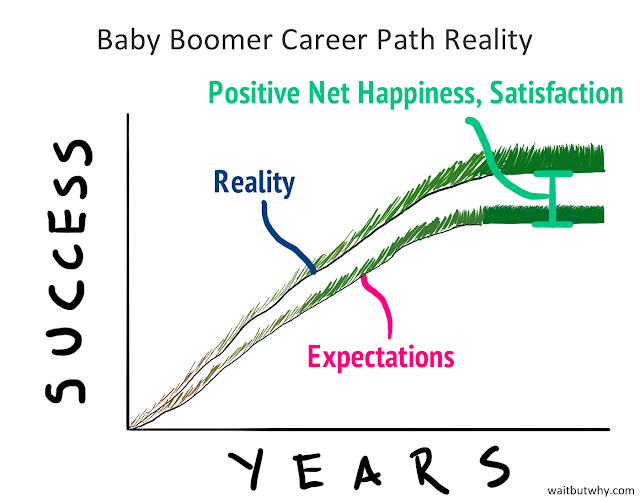

With a smoother, more positive life experience than that of their own parents, Lucy's parents raised Lucy with a sense of optimism and unbounded possibility.  And they weren't alone.  Baby Boomers all around the country and world told their Gen Y kids that they could be whatever they wanted to be, instilling the special protagonist identity deep within their psyches.

This left GYPSYs feeling tremendously hopeful about their careers, to the point where their parents' goals of a green lawn of secure prosperity didn't really do it for them.  A GYPSY-worthy lawn has flowers.


This leads to our first fact about GYPSYs:

GYPSYs Are Wildly Ambitious


The GYPSY needs a lot more from a career than a nice green lawn of prosperity and security.  The fact is, a green lawn isn't quite exceptional or unique enough for a GYPSY.  Where the Baby Boomers wanted to live The American Dream, GYPSYs want to live Their Own Personal Dream.  

Cal Newport points out that "follow your passion" is a catchphrase that has only gotten going in the last 20 years, according to Google's Ngram viewer, a tool that shows how prominently a given phrase appears in English print over any period of time.  The same Ngram viewer shows that the phrase "a secure career" has gone out of style, just as the phrase "a fulfilling career" has gotten hot.

To be clear, GYPSYs want economic prosperity just like their parents did—they just also want to be fulfilled by their career in a way their parents didn't think about as much.  

But something else is happening too.  While the career goals of Gen Y as a whole have become much more particular and ambitious, Lucy has been given a second message throughout her childhood as well:


This would probably be a good time to bring in our second fact about GYPSYs:

GYPSYs Are Delusional

"Sure," Lucy has been taught, "everyone will go and get themselves some fulfilling career, but I am unusually wonderful and as such, my career and life path will stand out amongst the crowd."  So on top of the generation as a whole having the bold goal of a flowery career lawn, each individual GYPSY thinks that he or she is destined for something even better—

A shiny unicorn on top of the flowery lawn.  


So why is this delusional?  Because this is what all GYPSYs think, which defies the definition of special:

spe-cial | 'speSHel |
adjective
better, greater, or otherwise different from what is usual.

According to this definition, most people are not special—otherwise "special" wouldn't mean anything.
Even right now, the GYPSYs reading this are thinking, "Good point...but I actually am one of the few special ones"—and this is the problem.

A second GYPSY delusion comes into play once the GYPSY enters the job market.  While Lucy's parents' expectation was that many years of hard work would eventually lead to a great career, Lucy considers a great career an obvious given for someone as exceptional as she, and for her it's just a matter of time and choosing which way to go.  Her pre-workforce expectations look something like this:

Unfortunately, the funny thing about the world is that it turns out to not be that easy of a place, and the weird thing about careers is that they're actually quite hard.  Great careers take years of blood, sweat and tears to build—even the ones with no flowers or unicorns on them—and even the most successful people are rarely doing anything that great in their early or mid-20s.  

But GYPSYs aren't about to just accept that.  

Paul Harvey, a University of New Hampshire professor and GYPSY expert, has researched this, finding that Gen Y has "unrealistic expectations and a strong resistance toward accepting negative feedback," and "an inflated view of oneself."  He says that "a great source of frustration for people with a strong sense of entitlement is unmet expectations. They often feel entitled to a level of respect and rewards that aren’t in line with their actual ability and effort levels, and so they might not get the level of respect and rewards they are expecting."

For those hiring members of Gen Y, Harvey suggests asking the interview question, “Do you feel you are generally superior to your coworkers/classmates/etc., and if so, why?”  He says that “if the candidate answers yes to the first part but struggles with the ‘why,’ there may be an entitlement issue. This is because entitlement perceptions are often based on an unfounded sense of superiority and deservingness. They’ve been led to believe, perhaps through overzealous self-esteem building exercises in their youth, that they are somehow special but often lack any real justification for this belief."

And since the real world has the nerve to consider merit a factor, a few years out of college Lucy finds herself here:
Lucy's extreme ambition, coupled with the arrogance that comes along with being a bit deluded about one's own self-worth, has left her with huge expectations for even the early years out of college.  And her reality pales in comparison to those expectations, leaving her "reality - expectations" happy score coming out at a negative.

And it gets even worse.  On top of all this, GYPSYs have an extra problem that applies to their whole generation:

GYPSYs Are Taunted

Sure, some people from Lucy's parents' high school or college classes ended up more successful than her parents did.  And while they may have heard about some of it from time to time through the grapevine, for the most part they didn't really know what was going on in too many other peoples' careers.

Lucy, on the other hand, finds herself constantly taunted by a modern phenomenon: Facebook Image Crafting.

Social media creates a world for Lucy where A) what everyone else is doing is very out in the open, B) most people present an inflated version of their own existence, and C) the people who chime in the most about their careers are usually those whose careers (or relationships) are going the best, while struggling people tend not to broadcast their situation.  This leaves Lucy feeling, incorrectly, like everyone else is doing really well, only adding to her misery:

So that's why Lucy is unhappy, or at the least, feeling a bit frustrated and inadequate.  In fact, she's probably started off her career perfectly well, but to her, it feels very disappointing. 

Here's my advice for Lucy:

1) Stay wildly ambitious.  The current world is bubbling with opportunity for an ambitious person to find flowery, fulfilling success.  The specific direction may be unclear, but it'll work itself out—just dive in somewhere.

2) Stop thinking that you're special.  The fact is, right now, you're not special.  You're another completely inexperienced young person who doesn't have all that much to offer yet.  You can become special by working really hard for a long time.  

3) Ignore everyone else. Other people's grass seeming greener is no new concept, but in today's image crafting world, other people's grass looks like a glorious meadow. The truth is that everyone else is just as indecisive, self-doubting, and frustrated as you are, and if you just do your thing, you'll never have any reason to envy others.
--
Original post in Wait but Why.

Friday, December 20, 2013

How To Tell If It's Love or Just Lust, by Michelle Alva.

Ever wondered if you were truly in love, or truly in lust?

Did you know that falling in love actually happens over time, and the journey from initial attraction to deep romantic love is a predictable course that depends on many different factors?

Love is an intense feeling of affection toward another person. It's a profound and caring attraction that forms emotional attachment.

On the flip side, lust is a strong desire of a sexual nature that is based on physical attraction. Lust can transform into deep romantic love, but it usually takes time.

Two individuals will transform their lust into love when they get to see the whole individual (their strengths and weaknesses) and get past the “fantasy level.

Dr. Helen Fisher, a well-known researcher on the topic of romantic love, has identified three stages to falling in love in her excellent book Why Him? Why Her?: How to Find and Keep Lasting Love and I've been inspired by her research in writing this post.

Which stage are you at?

Stage 1: Lust

Lust is the first stage of falling in love. It's driven by desire. The sex hormones play an important role in this stage. According to experts, this stage may begin immediately and can last up to two years.

Signs that you're in lust:

You're focused on the physical appearance of the object of your desire.
There is a strong desire to have sex, but not deep emotional conversations.
You’d rather keep the relationship on a fantasy level, not discuss real feelings.
You are lovers, but not necessarily friends.
Stage 2: Attraction

This is the “love-struck” phase. When you spend hours daydreaming about your lover; when you lose sleep or your appetite, you know you're in this phase. The neurohormones that play an important role in the attraction or infatuation phase are dopamine, norepinephrine, and serotonin. These are the hormones that send our heart racing, and might actually make us feel like we are going insane.

Stage 3: Deep Love and Attachment

When a couple has gotten to know themselves beyond the courting phase and they get to see their partner’s “whole” personality, including their strengths and weaknesses, and still choose to love and accept each other for who they are, a neurohormone of love called oxytocin takes over. This is the commitment hormone. It's released during orgasm and believed to promote bonding when adults are intimate.

The theory goes on that the more sex a couple has, the deeper the bond becomes. Socrates was correct when he said “where there is love there is madness.” Romantic love and addiction share similar brain chemistry. Therefore, if you are not interested in a serious committed relationship, Dr. Fisher advises not to casually sleep with someone, because you are likely to bond with the individual with whom you have an orgasm with. Basically we are kidding ourselves when we say we are going to keep it casual. Our brain is wired to bond and connect with a partner with whom we experience pleasure.

Signs that you're in true romantic love

This type of love is not just an emotion, it's also a craving. There is a strong emotional craving, the love drive is even stronger than the sex drive.

Possessiveness. When you desire only that one person, you know you are in deep romantic love.
You want to spend quality time together other than sex.
You get lost in conversations and forget about the hours passing.
You want to honestly listen to each other’s feelings and make each other happy.
He or she motivates you to be a better person.
You want to get to meet his or her family and friends.
You can’t stop thinking about that person.
At this stage, instead of a split between love and lust, your new path lies in the balancing of the two: committed love and red hot sex, security and excitement, continuity and novelty, safety and adventure, comfort and passion. The happiest couples are the ones that can maintain a balance between lust and love.

Enjoy the journey of self-discovery relating with someone for whom you lust. If the chemistry is right, it will transform into romantic love!

Don’t rush it; allow it to unfold naturally. The more you bring love, honesty, passion and romance into your own self-relationship, the easier it will be to attract someone who shares those same qualities.

--

Thursday, December 19, 2013

On loosing hope, by Chris Cade.

Recently I went through an unexpected breakup, and it has challenged me in a lot of ways I didn't see coming.

For example, this was the first time I'd ever broken up due to an abundance of love and the recognition that being in relationship with this person wasn't for the highest good.

There were no arguments, no friction, no conflict. Just a lot of love that wanted to be experienced and expressed in ways that couldn't work out.

This was new to me. My previous breakups were always due to fundamental problems between me and the other person that eventually led to the breakup. This time, my mind couldn't grasp the idea that an abundance of love was a completely valid, real, and important reason for a breakup.

Because of this, my mind began to notice all the ways I'd attached future experiences to this person...

For example, I had planned some really wonderful date ideas. And perfect gift ideas. Not just good ideas for dates and gifts, but rather, ones that were really attuned to the unique relationship that we shared. We both also knew that we would have lived an amazing life together, especially with incredible synergy in so many different ways.
    
As I felt into those feelings of perfect alignment and an incredible future, I realized how much I had emotionally invested in a future that didn't exist...

After the breakup, my mind kept coming back to all the ways we fit together perfectly. All the amazing ideas and expectations I had for the future. Or in another word:
    
All my hopes.

In really reflecting on hope, I came to understand what one of my spiritual teachers has been saying for years about the Hope / Desire / Rejection cycle.
    
In a nutshell, it works like this:

First we have a hope. An idea about some way we want our future life to be. Then that hope buries itself deeper into our heart as a desire. No longer is it just wishful thinking, it becomes a heartful wish.

At first that sounds great. Especially if we want to get more out of life. Unfortunately, that very cycle of hoping and desiring a better future leaves us in a state of rejection of the present moment. And given that the past is a memory and the future hasn't happened yet, the Present moment is the only thing that exists.
    
In other words, by me continually running the stories (and associated emotions) of a hopeful future, I was rejecting the only thing that actually exists: Now.

And to go deeper with that, every time I find myself sad or experiencing emotional pain, I have been able to trace it back to my hope about a future that I realize will not happen.

This has been an uncomfortable exploration.

My mind doesn't like the idea that my hope is actually causing me pain. It wants to believe that hoping for a different future will somehow bring me happiness. Unfortunately it doesn't. It can't. That's just not how the future works.

Consequently, I've been "losing" hope since the breakup.

Instead of letting my mind and heart get stuck running in circles hoping for a future that won't exist, I'm being more Present with my immediate experience. I'm learning what it means to let go of a non-existent future and to more fully embrace what actually is.

What is coming more fully into my experience is a sense of faith and optimism. I trust that all is for the highest good. I trust that as I deepen into the Present moment, that will cascade into future moments that will continue to be increasingly more amazing.

I don't know exactly how that will look. I just know that by "losing" my hope I'm opening up to, allowing for, and embracing, whatever magnificence the mysterious and unknown future has for me.

Less hope, and more faith. That's where I'm headed. :)

See, faith is fundamentally different than hope...

Hope has a very specific outcome that we attach to. We hope for things to turn out a certain way.
    
Faith on the other hand is unattached. It knows that things will turn out fine, even amazing, and that we can't know or imagine what that outcome will be.

Hope is born of our minds. It's of our egos. It tells us how it thinks the world should be. And then when life doesn't go the way we had "hoped," we feel the pain and rejection inherent within the hope.

Faith is born of our hearts and spirits. It's of our True Nature. It tells us that no matter how the world is, it is for the highest good. And then when life unfolds naturally as the mystery it is, we get to experience ourselves as heros on an adventure. Not knowing where the next turn leads, and still knowing the next turn will take us someplace important.

So yes, I'm "losing" hope. And I'm more optimistic and faithful than ever before. :)

Your Partner In Losing Hope,
Chris Cade
Liberate Your Life

P.S. Some wonderful shifts I'm experiencing by "losing" hope are...

A much faster transition through the breakup process. Pain is much more quickly transmuted into love. Hopes shift into faith and optimism. Unfulfilled expectations flow into gratitude. Feelings of being left behind or abandoned show me all the ways in which I'm incredibly supported.

I also am more fully experiencing and expressing unconditional love. My heart is expanding in directions I never could have "hoped" for, and for which I am grateful.

I've also learned that if I can walk away from an enjoyable, good, and loving relationship because it truly isn't for the highest good...

I'm making space in my life for the truly incredible, amazing, abundant relationship that I know is waiting for me... and that will be in alignment for the highest good.

I have no "hope" or expectation about how that Divine Right Relationship will look.

I just have faith and optimism that the Divine has got this one covered. :)

Tuesday, December 17, 2013

Gratitude Dispels Fear, by Lynne Forrest.

I was toss­ing and turn­ing dur­ing the wee hours of the night a while back. (I’ve found that the early AM hours are the time when the ego does its worst work.) This sort of sleep­less­ness has assailed me before. I awaken abruptly and lie there for hours com­pletely over­run with thoughts like, “what if this hap­pens or what if that doesn’t work?” –the kind of thoughts that don’t even occur dur­ing day time hours but feel over­whelm­ing at night. My habit in the past has been to lie awake feel­ing com­pletely at the mercy of such thoughts and pray for day­light so that I can escape them into my busy schedule.
But this time was different.
This time when the ego voice awoke me at 3 AM and started in on its pre­dictable rant I rec­og­nized its voice and didn’t take it quite so seri­ously. It still held sway for awhile, going on about about how dire my life sit­u­a­tion is, but this time I didn’t lose sight of who it was in me that was car­ry­ing on with such nay-saying. I decided to ask for help.
I sat up in bed, turned on my bed­side lamp and reached for the bible which hap­pened to be lying on a table near by. I sat with the bible on my lap a few min­utes and asked to be guided with words that would help me deal with the neg­a­tive fear-mongering ego that lives in my own head. I closed my eyes and opened the bible.
When I opened my eyes the first words I saw was the begin­ning of a psalm that said, “Praise the Lord.“I felt an imme­di­ate relief upon read­ing the words and thought, “OF COURSE that’s the answer to ego’s ranting!”
Praise gen­er­ates grat­i­tude; it uplifts the spir­its and raises our vibra­tional fre­quency to a higher vibra­tory level that attracts love and abun­dance. Grat­i­tude defeats ego com­pletely because it is of a much higher fre­quency. Ego can­not thrive in the high vibra­tional fre­quency gen­er­ated by prais­ing Source.
With that aware­ness in mind, I started whis­per­ing an impro­vised song of thanks­giv­ing for the over flow­ing abun­dance in my life. Peace and quiet joy descended. I did not go back to sleep. I did not need to. I was so filled with grat­i­tude that I felt eager to start my day. And it turned into a won­der­ful day — as days gen­er­ally are when I start out in an atti­tude of gratitude.
What is the les­son? Sim­ply this; grat­i­tude is the anti­dote for fear or any stress­ful feel­ing. Use it ceaselessly.
The next time anx­i­ety pro­duc­ing thoughts threaten to take you down, remem­ber that it is the ego that pro­duces fear — always. and turn to thoughts of grat­i­tude imme­di­ately. Find rea­sons to be grate­ful in every­thing you do and in every­thing that hap­pens. Refuse to hang out with the dark thoughts of an angst pro­duc­ing ego and you will find your­self held in the hands of an abun­dant universe.
--
Read the original post.

Monday, December 16, 2013

13 Uses For Lavender Oil: The Only Essential Oil You'll Need


If you only use one essential oil, this is it!

Lavender (lavandula angustifolia) is the most versatile of all essential oils. Most commonly known for its relaxing effects on the body, therapeutic-grade lavender has been highly regarded for the skin. It may be used to cleanse cuts, bruises and skin irritations. The fragrance is calming, relaxing and balancing – physically and emotionally. Carrying a bottle of lavender around with you is like having your own personal first aid kit, perfume and pick-me-up.

Here are 13 ways you can incorporate lavender in to your daily life:

1. Calming

Rub 2-3 drops of lavender oil in your cupped palms, then use the inhalation method to draw the scent all the way into your amygdala gland (the emotional warehouse) in your brain to calm the mind. Then, rub on the feet, temples, wrists (or anywhere) for an immediate calming effect on the body. Great for use in crowded areas like planes or subways to carve out your own personal oasis.

2. Sleep aid

Again, use the cupping and inhalation method. Then, rub a drop of Lavender oil on your palms and smooth on your pillow to help you sleep.

3. Bee sting / Insect bite

Put a drop of Lavender oil on a bee sting or insect bite to stop itching reduce swelling.

4. Minor burn

Put 2-3 drops Lavender oil on a minor burn to decrease pain. I recently did this after I spilled scorching hot tea on my hand at Starbucks and luckily had my lavender with me. Result: NO redness, swelling or pain. NO sign of any burn. Lavender works wonders!

5. Cuts

Drop Lavender oil on cut to stop bleeding, clean wound, and kill bacteria.

6. Eczema / Dermatitis

Mix several drops of Lavender oil with a nut or vegetable mixing oil (coconut, sesame, etc) and use topically on eczema and dermatitis. I have a dear friend who suffers from severe eczema and swears by this.

7. Nausea or motion sickness

To alleviate the symptoms of motion sickness, place a drop of Lavender oil on end of tongue, behind the ears or around the navel.

8. Nosebleed

To stop a nosebleed, put a drop of lavender oil on a tissue and wrap it around a small chip of ice. Push the tissue covered ice chip up under the middle of the top lip to the base of the nose and hold as long as comfortable or until the bleeding stops (do not freeze the lip or gum).

9. Dry or chapped skin

Rub lavender oil on dry or chapped skin.

10. Chapped or sunburned lips

Rub a drop of lavender oil on chapped or sunburned lips.

11. Hay fever.

Rub a drop of lavender oil between your palms and inhale deeply to help alleviate the symptoms of hay fever.

12. Dandruff.

Rub several drops of lavender oil into the scalp to help eliminate dandruff.

13. Cold sores.

Put a drop of lavender oil on a cold sore.

***BONUS: Flavor booster!

Add a few drops of lavender to any recipe you want to enhance. Favorites: add to your water or tea (especially sparkling!), brownies, bars, cookies, dessert recipes, raw chocolate or salad dressings. Enjoy!

As you can see, Lavender is an essential oil that can uplift your life (and mood), heal and entice in a variety of ways. It's a great secret weapon to have on hand at all times!

--
View original post.

Friday, September 27, 2013

I Didn't Love My Wife When We Got Married, by Elad Nehorai.

I'm a ridiculous, emotional, over-sentimental sap.  I guess that's why I told my wife I loved her on our second date.

I had tried really hard up to that point to hold it back, honestly.  I wanted to tell her on the first date, but I knew that would probably be weird.

I still remember her reaction.  She kind of gave me this half-shy, half-amused smile.  Then she nodded and looked off into the sky.

I wasn't heartbroken by the response.  I think part of me recognized that she was much smarter and more modest than me.

But as time has gone on, I also realized that she knew something that I didn't.

Like most Hasidic Jews (we both became religious later in life), our dating period lasted a very short time.  After two months of dating, we were engaged.  Three months after that, we were married.

And that whole time I was swooning.  This fire was burning in me, a fire that burned just like that second date: I was in love.

But then we got married, and everything changed.

Marriage, quicker than I was ready for, did this thing: It started sucking away that emotion.

I tried so hard to keep that fire going, to keep that emotion alight, but it got harder and harder.

I mean, how you can feel that burning love when you're sitting at the table discussing how to use the last $20 in your bank account?

How can you feel it when you get into an argument?

How can you feel it when you think it makes perfect sense to put your socks on the floor after you're done with them, and she has this crazy idea that they need to go in the laundry basket?

There was no way I could keep that dating fire burning as practicality invaded our lives.

And at first, it drove me nuts.  That emotion meant love!  That excitement was how I knew I cared for her!  But suddenly, life was this grind.  Even when I was with her.  Especially when I was with her.

And even worse, it seemed that the harder I tried to be sentimental and lovey-dovey, the less it was reciprocated.

But it wasn't that she wasn't giving me love, it just seemed to come at different times.

Like, when I offered to do the dishes.  Or make dinner after she had a hard day.  Or, once we had a daughter, when I shared the responsibility of watching over her.

I don't think I noticed this consciously for a while.  It just kept happening.

But I think it had an effect on me.  Because as our marriage progressed, I found myself offering to help out around the house more and more.

And after each time, there would be this look she would give me.  This look of absolute love.  One that was soft and so beautiful.

It took me longer than I care to admit to understand what was happening.

But eventually it became clear.  Through giving, through doing things for my wife, the emotion that I had been so desperately seeking naturally came about.  It wasn't something I could force, just something that would come about as a result of my giving.

In other words, it was in the practicality that I found the love I was looking for.

And what was even more interesting was that once I realized this on a conscious level, and started trying to find more opportunities to give, the more we both, almost intuitively, became lovey-dovey.

And now, as I'm a bit older and a bit more experienced with this relationship, I've finally come to realize something. Something I haven't wanted to admit for a long time, but is undeniable.

I didn't love my wife on that second date.

I didn't love her when we got engaged.

I didn't even love her when we got married.

Because love isn't an emotion.  That fire I felt, it was simply that: emotional fire.  From the excitement of dating a woman I felt like I could marry.  But it wasn't love.

No, love isn't an emotion or even a noun.  It's a verb.  Better defined as giving.  As putting someone else's needs above your own.

Why wasn't I getting reciprocal lovey-doveyness when we were first married?  Because it wasn't for her.  It was for me.  An emotion I had in my chest.

And even when I let it out of my chest, it wasn't love.

Being sappy isn't love.  Telling someone you love them doesn't mean that you do.

And that's why my wife just gave me that half-smile.  She knew, even if I didn't, what love really is.

And now that I've tried to change the way I look at love, the more I become shocked at the messages of love I had gotten when I was younger.

From Disney movies, to my favorite shows like The Office, to practically every pop song released, love is constantly sold as an emotion we have before we're married.  An emotion that, once had, somehow magically stays within a marriage forever.

I can't imagine a bigger lie.  And I'm saddened to think about how much those messages bounced around in my head for so long.  And how much I'm sure those messages are bouncing around in other people's heads as well.

I think that might be a big part of the reason the divorce rate is so high in this country.  Imagine a whole nation of people constantly chasing the emotions they had when they were dating.  A country of people trying to live a Disney movie.

That's a recipe for disastrous marriages; for a country with a 50 percent divorce rate;  for adultery (the classic attempt to turn the fire back on); for people who do stay together to simply live functional, loveless marriages.

It's sad to see just how common all the above is.  How many people are in pain simply because they've been lied to.

Those people deserve better.  We all deserve better.

It's time that we changed the conversation about love.  It's time that we redefine it.

Because until we do, adultery will continue to be common.  Loveless marriages.  Divorce.

Living Disney movies in our minds, and tragedies in our lives.

--

Elad Nehorai is a writer living in Crown Heights, Brooklyn. Five years ago, he became a religious Jew in the Chabad Hasidic community and has since written about his experience extensively, most recently in his blog Pop Chassid, where this post originally appeared. He's also the CMO of a startup called Charidy designed for people who want to help give to nonprofits. You can find him on Twitter as @PopChassid and Facebook.
See the original post, here: http://www.huffingtonpost.com/elad-nehorai/i-didnt-love-my-wife_b_3908956.html

Sunday, September 22, 2013

10 Signs you've found your calling, by Lisa Rankin, MD.

How can you tell if you’ve found your calling? As a doctor who was called to medicine at a young age but then wound up disillusioned by the system, questioning my calling, I’ve asked myself this question a lot. It’s been a long strange trip- first leaving medicine, then feeling called back, then leaving again only to find my role in healing our broken health care system as a writer, speaker, revolutionary, and teacher of physicians. Along the way, I’ve learned a few things about how to know whether you’re on the right track.

1. You’ll realize you’ve been training for your calling since the moment you were born.

Even the gritty things, the disappointments, the regrets, and the screw ups, they were all prepping you for what you’re now being called to do. You’ll realize that the divorce, the bankruptcy, the death of your loved one, the failure, the rejection- it was just school, teaching you the lessons your soul needed to learn in order to be who you’re being called to be.

2. Mystical things will start happening.

You might be tempted to write them off as coincidences, only they’re too perfect, too exactly what you need in that particular moment, too much like miracles to call them accidents. The synchronicities will fill you with a sense of wonder, because they’re proof positive that you’re being guided, that you’re not in this alone, that Someone is moving mountains to ensure that your mission is a success.

3. When you get off course, you’ll get redirected.

Doors you longed to walk through will slam shut. If you take the wrong fork in the road, your path will be littered with barbed wire and mustard gas and dragons and sharp knives lining the path. You will get the hint that you’ve made a wrong turn, steering yourself off course from your date with destiny, when the journey becomes a relentless struggle.  The deal will fall through. The money will run out. The mentor who’s been providing the magical gifts won’t follow you onto the wrong path. People won’t sign up. You’ll be rerouted just as magically as you were steered to your calling in the first place.

4. You’ll be guided by ease, even in the face of obstacles.

When you find yourself struggling to get through an obstacle-ridden forest, it can be hard to tell- is your commitment just being tested, or have you veered off course?  Obstacles can be part of the growth process, the cultivation of your inner hero, a necessary part of your hero’s journey. But they can also be signs that you’ve made a wrong turn. How can you tell the difference? The guidepost you can trust is a sense of movement towards ease. If the challenges are mounting, things are getting worse, one hard struggle is piling upon the other, you’ve probably gotten seduced off course from your true calling, and the Universe is just waiting patiently, twiddling Divine thumbs because you have free will, but never giving up faith that you will find your way back to your calling, which will always lead you to your own holy grail. When you’re back on track, things start to flow again.

5. Magical mentors will appear just in the nick of time.

Just when you need it most, the right people will show up, with just the tools you’ll need to support you and your journey in an almost mystical way.

6. Your health is likely to improve.

A strange but welcome side effect of finding your calling is that your health is likely to improve. You may notice fewer cravings for unhealthy foods, you’ll have more energy for moving your body, aches and pains that used to plague you might disappear, you’ll feel less tired, and chronic illnesses you may be battling may start to get better.
Take Andy Mackie, for example. At 59 years old, Andy Mackie had undergone nine heart surgeries and was taking fifteen medications to try to keep him alive, but the medicines left him feeling horrible, so one day, he told his doctors he wanted to stop the drugs. They told him if he did, he would die within a year, so Andy decided if he was dying, he wanted to do something he’d always wanted to do. So he took the money he would have spent on his medications and used it to buy 300 harmonicas, and he gave them away to children, complete with harmonica lessons. The following month, he was still alive, so he bought another 300 harmonicas. Thirteen years and 20,000 harmonicas later, Andy Mackie finally passed away.

7. You may find that money flows in just as you’re ready to throw in the towel.

I’m not suggesting that you won’t wind up in debt or staring at an empty bank account when you used to have a full one or even bankrupt. But if you’re on the right path, you won’t wind up living under that freeway overpass near what used to be your house, and you may find that money appears almost magically once you’re really right in the dead center of your life’s purpose.

8. You may feel strangely peaceful, even when you have every reason to be anxious.

Everyone around you will likely think you’re crazy. A part of you will agree with them. But a wise inner knowing, that part of you I call your Inner Pilot Light (link), will be so comforted by the fact that you’re finally on the path to your purpose that you may feel unusually calm- until your rational mind kicks in.
Our souls long to express what we’re here on this earth to express, and when you finally fall into alignment with your calling, your soul does a little happy dance.  It may appear as if everything else in your life is falling apart, but you’ll have this sense of peace, a huge relief, that at least- finally- you know what you’re called to do.

9. The Universe will roll out the red carpet.

When what you’re being called to do is what is needed for the highest good of all beings, the Universe will bend over backwards to hand you whatever you need on a silver platter. No request is too small. A copywriter may volunteer to help you just when you were thinking you needed to write a sales page. Someone will donate a printer when it’s time print a flyer. You’ll feel so supported, so lucky, that you’ll know you’re on track, even if you’re not quite clear what you’re on track to do.

10. Your people will find you.

Few can fulfill a calling alone. Most of us need a tribe to lift us up as we do brave, scary, world-changing things. But don’t worry. When you’re really on purpose, your people will find you, if only you’re courageous enough to be vulnerable about what you’re being called to do.

Do Any Of These Sound Familiar?

Have you found your calling?  Or are you still looking for it? If you’ve found your calling, YEAH! The world needs you! Blessings to you on your hero’s journey.
If you haven’t, don’t worry. We won’t leave you hanging. Martha Beck, Amy Ahlers, and I recorded a free 90 minute teleclass to offer you tips on finding your calling. (You can listen to the recording here.) We’re also about to start a whole program Find Your Calling: Awaken Your Life Purpose, Clarify Your Vision, and Do Your Soul’s Work. Read more about the 7 week teleclass series and sign up here.
Trusting your journey, wherever you are,
--
Read the original post, here.

Friday, September 20, 2013

Spiritual Awakening: From Victim Consciousness to Source Realization, by Lynne Forrest

We are each on a jour­ney. In my opin­ion, that’s why we’re here — to play out in con­crete form our own belief sys­tems, for the sake of con­scious­ness, and so that we might learn to adjust our thoughts to a higher fre­quency and bring an end to our own, self-made, suffering.
Nobody said it would be easy. Earth life is boot camp for the prac­tice of remem­ber­ing who we truly are. :)
For it is our thoughts that deter­mine the qual­ity of our life expe­ri­ence. Some of our thoughts have been with us since the begin­ning; they are ‘core’ beliefs, those ever present assump­tions, that most of us have never ques­tioned, and that, we believe, define us and the world. Our core beliefs dic­tate the route and the unfold­ing of our con­scious­ness journey.
Our thoughts trans­mit an energy, the fre­quency of which is then trans­mit­ted out to the world around us. The vibra­tional qual­ity of our thoughts and beliefs exude a mag­netic charge (men­tal energy IS electro-magnetic) that attracts to us the peo­ple and events that will, in fact, mir­ror back to us, in tech­ni­color, (I like to say, “for our view­ing plea­sure,”) the har­vest of our own thoughts and beliefs. This is the way life in Real­ity works.
Our core beliefs there­fore become the vibra­tional foun­da­tion of a psy­che that is built on a (most often unhappy) story about who we are and what we can expect from the world. The vic­tim tri­an­gle is where that story gets played out. As I’ve said many times, “the Vic­tim Tri­an­gle is the play­ing field for ALL dys­func­tional inter­ac­tion. Mov­ing around the tri­an­gle is the way we play out our unhappy core beliefs and prove to our­selves that they are true.
When we are on the vic­tim tri­an­gle, we live in a state of , what I call, “vic­tim con­scious­ness.” Dr Stephen Karpman’s Drama Tri­an­gle defines the three basic roles of vic­tim con­scious­ness as the Vic­tim, Per­se­cu­tor, and Res­cuer; these roles are actu­ally defense strate­gies that we resort to when­ever we get into believ­ing our unhappy story. As with most defenses, rather than to pro­tect us, our defense strate­gies sim­ply end up help­ing us gather evi­dence for our unhappy story. This is the root cause of all dys­func­tion and suf­fer­ing. For those who live in the shadow of an unhappy story about who we are, life becomes mis­er­able, even intolerable.
Most of us auto­mat­i­cally believe the unhappy thoughts/stories that we think; it never occurs to us NOT to believe them. It’s all we’ve known or seen. Our par­ents and grand­par­ents, gen­er­a­tions that go all the way back in time, lived their lives blindly believ­ing sim­i­lar unhappy sto­ries about them­selves and the world. They, like us, never ques­tioned their thoughts. How, there­fore, were we to know that we don’t have to believe what we think? As a race, we are only now begin­ning to awaken to that real­iza­tion. And what free­dom it brings when we DO finally get it!
How we prove our life beliefs, what­ever they are, is encap­su­lated in what I call the “Real­ity For­mula™, which out­lines in sim­ple terms how we, as humans, set about prov­ing the thoughts we believe. The Real­ity For­mula says this: “When we believe what we think, we auto­mat­i­cally feel as if it’s true, and act as if it’s true, which prompts us to react in ways that prompts oth­ers to prove us right.”
Inter­est­ing, isn’t it, how con­sumed with being right we are? We are will­ing to live years — for some of us, our whole life is spent in a mis­er­able com­pe­ti­tion, set on prov­ing we are right in our unhappy con­vic­tions about our­selves and others.
For instance, if Sue believes that oth­ers aban­don her, she will auto­mat­i­cally feel all the feel­ings that go with that think­ing, and she will act accord­ingly. She will be para­noid and dis­trust­ful, always sus­pi­cious of their motives, and inter­pret­ing their behav­ior in ways that con­firm her sus­pi­cions. She may become needy and clingy, hop­ing to con­vince the other to stay … how­ever the very things she does to try and keep from being aban­doned, actu­ally drive them away instead. Is it any won­der that she gets left, as pre­dicted, once again? What Sue doesn’t see is her own part in the act, i.e., how it is she aban­dons her­self by act­ing in ways that push her loved ones right out the door! This is one small exam­ple of what it is to live in vic­tim con­scious­ness. We blame the world around us for the unhap­pi­ness we feel, and remain clue­less that it is we who hold the key to free­dom and peace, that comes auto­mat­i­cally when we learn to ques­tion our beliefs.
Once we become aware that we don’t have to believe the unhappy thoughts we think, we have offi­cially, and con­sciously, begun our spir­i­tual jour­ney Home. This is the long, wind­ing road off of the vic­tim tri­an­gle and out of vic­tim con­scious­ness that we each must take, one step at a time, towards higher ground. In the process of awak­en­ing, we will move in and out of our unhappy sto­ries, on and off the vic­tim tri­an­gle, becom­ing increas­ingly con­scious as we go, which allows us to reframe our old, unhappy beliefs to a gen­tler, kinder vibra­tion, opens us to a hap­pier per­spec­tive, and makes pos­si­ble a more peace-filled world.
This then is the path to enlight­en­ment, which is sim­ply to awaken and align, here and now, with Real­ity, which sheds the light of Under­stand­ing upon us. Through its radi­ance, any and all unhappy story about our­selves or the world is abol­ished, allow­ing us to see clearly instead the Truth in the Way things are.
I had the fol­low­ing anal­ogy come to mind as a metaphor for our life jour­ney to consciousness:
I saw the con­scious­ness jour­ney in com­par­i­son to being on a road trip and pulling into a gas/convenience store to “fuel up” for the trip. (It is our crav­ings in life that often deter­mine our stops and starts) We stop, not only because we need to fill up our vehi­cle with fuel, but because we seek dis­trac­tion from the long road ahead. We want some­thing to make the trip more appeal­ing, and being rel­a­tively new on the road (to con­scious­ness), we seek some­thing “for the palette” in the form of a treat that we fan­ta­size we will find on the aisles inside the store.
This is how we often start out on the road to con­scious­ness. We want to make the trip, but we seek dis­trac­tion, the eas­ier, softer way of trav­el­ing. What we often don’t see is that our so-called treat quickly turns into an unkind treat­ment of ourselves!
To con­tinue the anal­ogy: We go straight to the candy row and walk up and down the aisles look­ing for what appeals to our taste buds — we see temp­ta­tion on every shelf. The seduc­tion of color and promise prompt us to totally dis­re­gard the con­tents or ingre­di­ents we are about to ingest; we are not con­cerned with whether it’s nutri­tious, or the long term effect on us at all. Our ulti­mate well-being is ignored. We are look­ing for a short­cut to feel­ing good RIGHT NOW and this is the best promise of momen­tary dis­trac­tion avail­able to us now. With no regard for pos­si­ble con­se­quences at all, our crav­ings take over and dic­tate our choices.
Need­less to say, much of our con­scious­ness jour­ney is spent here on the “candy row” of life — seek­ing dis­trac­tions, pal­lia­tives that will med­icate the dis­com­fort and suf­fer­ing that goes with believ­ing the unhappy sto­ries we tell our­selves about how hard life is. We want to progress on our spir­i­tual pil­grim­age … we have set our inten­tion on move­ment for­ward, an essen­tial part of get­ting there, but at the same time we are eas­ily dis­tracted by the glit­ter and promise of dis­trac­tions along the way.
We pay the price of dis­re­gard­ing our well-being in exchange for fleet­ing plea­sures, but there are ben­e­fits as well. Not only do we gain wis­dom through life expe­ri­ence, but through sam­pling these dis­trac­tions, we dis­cover their illu­sion­ary nature and become bet­ter skilled at choos­ing eter­nal things instead. This is what it is to grow up spiritually.
The spir­i­tual path is indeed about the mat­u­ra­tion process. Spir­i­tual Con­scious­ness is the mature aware­ness that allows us a depth of love and com­pas­sion for our­selves first, and then for oth­ers, that only those who have walked the byroads of life, learned from their life expe­ri­ence, and grown from their own mis­takes, can offer.
And so it is for us on the jour­ney to greater con­scious­ness. We are led around by our crav­ings and car­nal desires, with no thought of the cost to us. We sim­ply react to life, with no real thought about what we are believ­ing or why we do what we do. We live in this state of imma­tu­rity for a long time … some for life. Never mind, it IS a legit­i­mate stage of the jour­ney, for it is the place of launch. Sooner or later, we begin to make the con­nec­tion between the suf­fer­ing we feel and the beliefs we feed our­selves (we see the illu­sion of what the candy counter offers).
Per­haps you think that from here we should go imme­di­ately into chang­ing our ways, avoid­ing those candy aisles, and never again doing any­thing that is not in keep­ing with our high­est good, right? Not nec­es­sar­ily so. That is rarely the way it works. Instead, most of us keep right on mak­ing those trips to the candy row and suf­fer­ing the results — but the effect is com­pounded now because we suf­fer the guilt and remorse from going against what we feel is best for us. We are embar­rassed, or ashamed that we don’t have more con­trol … some of us may go into hid­ing about what we’re doing. We may resort to deny­ing or hid­ing or jus­ti­fy­ing our choices out of guilt, or for fear oth­ers may judge us as fiercely as we have judged our­selves for our “weakness.”
These are all com­mon responses on the road to wak­ing up. We see how we shoot our­selves in the foot, but we don’t seem to be able to con­trol it. We resort to feel­ing bad about our­selves, and think of our­selves as fail­ures that can’t ‘get it.’ But it is actu­ally the design of the road to con­scious­ness, a road full of twists and turns, and dou­ble backs, where we get to see up close the work­ings of our own mind. We lear to meet temp­ta­tion with­out self-deprecation, allow­ing us to learn from our responses, and become kinder and more accept­ing in the way we see ourselves.
Slowly, as we become more sea­soned trav­el­ers, how­ever, we learn to wit­ness (devel­op­ing our observer state) our doings with­out so much judg­ment. We grow in expe­ri­ence. From observ­ing the out­comes of our choices we begin to slowly, ever so slowly, make health­ier choices. This is what it is to develop an Observer Self, the wit­ness who sees and grows from what is seen, with­out the need to resort to blame or judgment.
But even when we make bet­ter choices, we are often not sat­is­fied. There is an inner crav­ing for imme­di­ate grat­i­fi­ca­tion that may keep us fix­ated on the false promises held out by the lit­tle ran­cid snacks in col­or­ful pack­ages, that call out to us to save them from their dusty shelves where they have been stored for who knows how long; it’s the promise of some­thing good, of some­thing fun, that dis­tracts us from the false empti­ness of their offer­ing, and promises us fleet­ing pal­lia­tive dis­trac­tion from our story about a monot­o­nous jour­ney that seems to us in the moment to be noth­ing but inter­minably long and boring.
This is just like us in real life. We live out our unhappy sto­ries on the drama tri­an­gle, and find our­selves drawn to glit­ter­ing promises of dis­trac­tion and relief. We often become relent­less in seek­ing dis­trac­tion and escape from the path we are presently expe­ri­enc­ing, sim­ply because we tell our­selves we should be some­where else, doing some­thing more worth­while, and then fail to see the immense pos­si­bil­i­ties offered us in this present moment. As a result, we miss out on the ever present alive­ness that only life-in-the-happening moment can offer. Instead we too often set­tle for ran­cid candy treats to lessen the sting of not being in the moment.
As we progress (given we choose to progress), there comes a time when we walk right by the candy row, with­out giv­ing it any notice at all. It no longer holds an inter­est for us, not because we are avoid­ing it, or ‘should­ing’ our­selves away from it, but because we are aligned with a higher fre­quency, and no longer find it enticing.
We have aligned with Real­ity, and come to rec­og­nize false promises for what they are, illu­sions that pro­vide no nour­ish­ment for us. We have devel­oped a taste for sweeter, more sus­tain­ing, long-lasting, things, with which no candy counter can com­pete, and we are no longer will­ing to set­tle for less.
This is a good metaphor for the way it is on the jour­ney to Awak­en­ing, as I see it. Awak­en­ing is a process of learn­ing how to choose what is real over false promises of ful­fill­ment that leave us emp­tier than before.
I invite you to awaken from vic­tim con­scious­ness by ques­tion­ing your long-held, blindly-believed assump­tions about your­self and life. Allow your­self the process of a jour­ney that takes you a step at a time closer to what’s Real, and to the mem­ory of who you really are and why you are here in Reality.
Bless­ings,
--
Lynne is a Real­ity Guide & Per­sonal Growth Men­tor. Lynne was edu­cated through a life time of study­ing and observ­ing meta­phys­i­cal life prin­ci­ples taught to her early in life, and learn­ing how to apply those prin­ci­ples to her own life in pos­i­tive ways. She has been shar­ing her find­ings with oth­ers and watch­ing their lives trans­form since the sev­en­ties, and has sup­ported her­self and her fam­ily through a pri­vate prac­tice, which was founded on those prin­ci­ples in 1985.
See the original post, here.

Sunday, September 15, 2013

How Emotionally Mature are You in Love?, by Gina Hardy.

Most of my lovely couples come to me in relational angst when their bag of long standing coping “tools” has run aground and they have nothing left with which to communicate their feelings and needs in a healthy way.

Many couples just cope, rather than experience deeply fulfilling and nourishing relationships, because they feel, it’s “better not to rock the boat…”, “it’s easier this way….” “I can’t bear the thought of losing my husband/wife, so I’ll do anything…..” “Well we have kids and so we must stay together…”

Too many arguments or the lack of them, create all sorts of symptomatic behavior of two inner children trying to get their needs met that somehow escaped them in childhood.

Have you ever noticed yourself or others, when you are in conflict, how childish the words and body language is?

“You always do that….!” “You don’t love me…..!” “I hate you…..!” “You never let me do anything I want to do….!”

Tasmanian devil body language, slamming doors, shutting down, throwing yourself on the bed, running out of the house, throwing things, bolting the door, pushing your partner away. The list goes on. Are any of these familiar?

It seems the deeper the conflict the more your inner child will show itself in all it’s stunted glory because what you need the most, is being threatened not to be available.

From the moment we are parted from our mother’s umbilical cord and experience separateness, the inner demons are born. Some spiritual folk say the Light (love) is born alongside the dark (fear). The brain stem or “old brain” as the Imago Relational experts call it, is watching out for signs of impending death, hence the power of this part of the brain and its flight / fight protective response.

As a baby, the feeling of our parents/caretakers being near is of utmost importance. We are safe when they are around. If they are absent, the fear of death is alerted within the psyche and over the years can develop into severe psychological disturbances.  Thankfully most of us are not severely disturbed but I do feel we all suffer from some degree of emotional lack of care at some stage in our lives and that shows up like a clear blue day in our intimate relationships for the distinct purpose of healing it and growing beyond it.

The saying goes that you truly connect to your deepest knowing when you suffer and I, for one, know this to be true. I have met people and thankfully for them they haven’t had any great upheavals in their lives thus far, but on another level appear disconnected from the Self. I wonder then that emotional maturity is connected, in part, to how deeply you have suffered in your life time and more importantly what you have learned from your experiences.

Throughout life all we need is love, approval and safety to develop in a healthy way. That’s it, end of. However many of us have not had equals or large measures of all of the above and so wherever lack is felt at whatever stage of growth, we will relive it when we fall in love. How do I know? Because I see it every time I work with couples.

It’s like the mini explosions of the love within, cracks open all the mucky bits that float to the surface for healing and releasing with the assistance, but often not easily, with our significant other.

Emotionally fit people have exercised their emotional muscles. They are able to understand themselves and how they feel in every situation and have learned the art of communicating in a healthy non-threatening but boundaried way.

Intellectual fitness doesn’t mean people are emotionally fit as well. You need to spend time on both. I know many intellectually fit people, who have amazing jobs/careers, but have disastrous love lives!

Some things to spot in emotionally immature people that may not bring you a happy relationship:

1.  Age, particularly with men, DOES have something to do with emotional fitness. I have dated much younger men in the past 25 years and longed for an emotional hunk but got an emotional fledgling. No fault of their own, just age and life. Ladies, I urge you. Have a good time but beware. Statistically men are less emotionally mature than women, so chasing after little inner boys when you want a mature conscious relationship, may end in tears after the honeymoon stage transitions.

2. Out of control emotions. Emotionally strong people can look at what’s coming up inside them and be able to articulate it without kicking off. Does your relationship suffer regular rows, nasty words, blame, judgment, criticism or even physical abuse? None of us are perfect and this one sweeps up a whole chunk of the global population because, let’s face it we all judge and criticize every day. Protesteth not! But we can always find the room to work on it. What we judge is in us!

3.  Unable to show/discuss feelings – many women will say “oh lord this is so my man!” . It’s interesting thought because many people who remain calm, stoic and won’t be rattled are not necessarily emotionally fit. They speak of being the sensible peacekeepers in times of conflict but will not show up emotionally and explain how they feel. This can be deemed as passive control. Behaviors range from, hiding away in rooms, books, at the pub or on the golf course and avoid talking at all costs. Emotional avoidance doesn’t exercise the muscle; it keeps it limp and weak!

4.  The perceived easy life – as described before, suffering generally connects you to the Self. I dated a guy ten years ago, who on the outside, came from a good stable background, but he had experienced little suffering in his 26 years. Not that I wished that on him but when I showed up as Mrs. Emotional Pants, he couldn’t seem to really get how I was feeling when things got tricky. He hadn’t been there and so had no recollection of feeling those emotions.

You could label such behaviors as Asperger’s Syndrome – which in essence is an inability to socially interact. Wikipedia describe it as a genetic disorder which I believe to be a load of baloney, because as Bruce Lipton would correct, these conditions are developed as a direct result of our environment i.e our upbringing.

Exercising the emotional muscles within your relationships can be done in a variety of ways:
1.  SELF development – you don’t need me to tell you where to go nowadays but the self-development industry has evolved through people seeking love, safety and approval within themselves. Naturally with introspective processes comes the ability to mature emotionally as you choose to explore every feeling and emotion to their fullest. “Everything is energy” is the growing mantra. What you become, so you attract. Self-development is the ability to turn around on your life path and look at yourself warts and all and to begin to clear out those bits that hold you back. As you heal from the past, so you emotionally grow.

2.  Argue – yes that’s right! Arguing exercises the emotional muscles, particularly for those who find it hard to talk. Practice airing your views and feelings. Encourage each other to go for it. To make it more palatable, encourage each other to hold stage and vocalize thoughts and feelings while the other keeps quiet. Want that for each other. Truths rarely come out with people who say “oh we never argue.” No wonder at it that these people often suffer physical ails like migraines, depression and anxiety!

3.  Learn to communicate with your beloved in a healthy way. You can get tips and hints on my comms blog:  http://www.ginahardy.co.uk/category/communication. In any situation I encourage you to use the following language:

“When you do that darling, I feel sad/lonely/hurt/frustrated/irritated….” “I could really do with a cuddle/some time talking/help with the laundry children etc…..” “What feels/doesn’t feel good for me is….?” Conscious languaging will get you heard in an easier non-threatening way. Be willing always to serve your relationship by expressing what you feel and what you need. Work as a team. So there you have it. A few thoughts and some energy about emotional maturity. Like anything, we need to practice, practice, learn, and learn. The journey of you is indeed the best one you will ever take, so do yourself a favor; help your planet by aiming to be the best you can be. Emotional immaturity causes wars and pain. That’s old paradigm. Belong to the new every time.

---
Original post here: http://omtimes.com/2011/04/how-emotionally-mature-are-you-in-love-2/ About Gina Hardy: http://www.ginahardy.co.uk If you would like to try Conscious Dating and want to connect with a community of like-minded souls on the same path as you, visit http://AscendingHearts.com

Tuesday, August 13, 2013

Do you hide your light from others?, by Alexandra and Dan.

"Dear Saint-Germain, I love learning new and alternative ways to heal. I want to help others with what I already know, but I would still like to learn more. Right now I’m involved with homeopathy, reflexology, Reiki, and yoga. 

"My big problem is stage-fright. I have difficulty getting up in front of others, no matter what I’m doing. I feel exposed, so I find myself hiding my light. This keeps me from offering all that I am in service to others. Can you help me?" 

My dear friend, I AM Saint-Germain. 

It is clear that you have a great love of knowledge and an affinity for the healing arts. You are also drawn toward sensitive expression of all kinds, and this is something you should encourage in yourself as you go through life. You understand things easily, your interests are diverse, and your desire to use your creative talents is admirable. 

You love learning, teaching, and performing, as well as being in compassionate service to others. However, as you already mentioned, you’re experiencing some discomfort in doing this. You call it “stage fright” or performance anxiety. But in reality, it has more to do with how you relate to others emotionally, how you maintain your personal boundaries, and how willing you are to get to the depth of your experiences. Here is what I mean by this.

Subconscious emotional patterns
You are naturally attracted to positions of leadership, where you can demonstrate and share what you know with others. Yet, you can also feel uncomfortable being in front of people, whether these are friends and peers, or individuals you haven’t met before. 

This is largely due to subconscious emotional patterns that you carry within you. These may come from past lifetimes or earlier in this lifetime. But what they share in common is a conditioned expectation that you will be shamed, embarrassed, threatened, or hurt if you speak out or perform in front of people – no matter how much you might want to do this. 

What this suggests is that self-worth and esteem are involved here, as well as knowing that you are safe and secure in the world, and that you can trust others. 

This is the reason that you may feel challenged to move beyond your love of learning, to interacting more with your clients. To do this requires you to establish bonds of trust, and this could feel emotionally threatening to you. This is one of the main reasons you feel anxious in front of people, something that you are calling “stage fright”.

The perspective of neutral observation
You are being encouraged by your Soul to detach from the anxiety and discomfort that you feel when you are around people. This anxiety simply reinforces the belief that being seen as you really are, is an avenue to ridicule and shame, or a threat to your self-esteem. 

Of course, this doesn’t mean that you should suppress or deny your feelings, or stop expressing yourself. It simply means that you should put things in perspective. It means that you would benefit from assuming the perspective of the neutral observer as much as you can, until you learn to feel more comfortable around people. 

When you take up the perspective of the neutral observer, you are calling upon your capacity to watch yourself as you interact with people, without getting caught up in the fear of being embarrassed. It is a detached and humble kind of self-assurance that doesn’t depend upon the validation or approval of others. 

You've learned to hide your light from others in order to protect yourself and not expose your sensitive feelings to rejection. But this is not working for you any more. Instead, if you can learn to let yourself be seen, instead of fearing that you will be hurt if you are exposed, then you will allow others to connect with you in a heartfelt way. This is how they will learn to trust you as a healer, and how you will learn to serve them as a provider.

When you assume the perspective of the neutral observer, it’s easy to remember your worth and abilities, and just go from there. You won’t be fearful about the impression that you will make on others, and your clients will sense this and relax. As a consequence, you’ll be able to focus on applying your skills, and your clients will be able to receive the treatment and care they seek from you. 

As you reach this place of neutrality, try shifting your attention to helping your clients. An attitude of service is a good remedy for performance anxiety because it takes the spotlight off of you, and allows you to shine your healing light on them, instead.

Staying open, while maintaining boundaries
Yes, as a healer you will need to establish trust with your clients as you serve them. You will do this by staying open to them emotionally, but within appropriate boundaries. This means that you must be available to inspire and uplift them, so that their healing is facilitated by your care and concern – but without getting pulled into their drama or suffering, which would only debilitate you and encourage their dependence. 

Maintaining appropriate boundaries with your clients means that you will need to establish your position as a professional who serves them, but not give away ground or disadvantage yourself by feeling uneasy around them. If you do, then you will soon find that there is no place left for you to stand. Remember to trust yourself and the Spirit that guides you. Have confidence in your ability and don’t depend on the approval or recognition of those you serve. It’s enough that the work is done.

Getting to the depth of your experiences
You are motivated by high ideals and a love of healing knowledge, but now you will need to ground these in the practical organization and execution of your craft. This is going to require your focus, discipline, and renewed commitment.

Remember that it will soon be time for you to get to the depths of your experiences as a healer. This means that you will have to make a commitment to staying focused, and not allow yourself to get sidetracked by competing interests or the temptation to try out everything that attracts you, without mastering any single modality. 

What is important for you right now is that you thoughtfully examine everything that you want to be doing. Look at this, and be honest with yourself about what really matters to you and what you want to achieve with your career. How do you want to step out into the world of service as a healer? 

You do love knowledge, it’s true. You’re someone who’s born to illuminate your mind by the light of your spiritual lamp. This means that you will be motivated to learn about the things that feel good to you and that you connect with deeply – and this is how it should be. But what you need now is to ground and focus your spiritual desire, so that you can step into meaningful and knowledgeable service as a healer. 

Your Soul is encouraging you to trust yourself more, remain confident in your skills, and have faith in the spiritual processes that are operating behind the scenes in your life. There is a great transformation taking place in your life now, and it’s going to continue for the next few years. So, be willing to accept what’s offered to you, if it feels right. Trust your intuition in this, as this IS the voice of guidance speaking to you in your moments of calm stillness. 

Remember that you are dearly loved, my friend. I AM Saint-Germain.

--
This material is offered to help free us from limitations by expanding human consciousness. It may be distributed without charge, provided this intention is honored. Commercialization by other parties requires the expressed written consent of the copyright holders, Alexandra and Dan. If you are reproducing this material, please credit the authors by name and include the following link: http://www.joyandclarity.com
© copyright 2007-2012 Alexandra and Dan
This message was originally posted here

The Power of Vulnerability, by Brené Brown

At the end of 2010, a reseacher named Brené Brown gave a talk at her local TEDx event, TEDxHouston. That talk, “The Power of Vulnerability,” has since become a web-video phenomenon — viewed and shared by millions of people, who write us to say that her words — on shame, vulnerability and honesty — moved them, inspired them, helped them make change in their own lives. (It has also inspired at least two tattoos.)


When we invited Dr. Brown to speak at TED2012, she shared the impact her new fame has had on her own life and how putting her words on this big stage has caused her to reexamine what she knows about vulnerability. Before she spoke, our own Roxanne Hai sat down with Dr. Brown to ask her a few questions about the nature of vulnerability.


What’s the greatest lesson you have learned in your own life?

When you get to a place where you understand that love and belonging, your worthiness, is a birthright and not something you have to earn, anything is possible. Keep worthiness off the table. Your raise can be on the table, your promotion can be on the table, your title can be on the table, your grades can be on the table. But keep your worthiness for love and belonging off the table. And then ironically everything else just takes care of itself.

How has your own journey in vulnerability and authenticity changed as you’ve become more well known and your work has become more well known?

Oh, it’s been hard. I call 2010 the year of the vulnerability talk and 2011 the year of walking the talk, because I was very unprepared. I so believe everything I said, and I really am trying to live that way, but I’ve become very clear in the last year that it is more complicated and more difficult than I thought.

One of the things I did when I discovered this huge importance of being vulnerable is very happily moved away from the shame research, because that’s such a downer, and people hate that topic. It’s not that vulnerability is the upside, but it’s better than shame, I guess. And what I realized over the last year is, if you don’t understand shame and you don’t have some shame resilience and awareness, then you cannot be vulnerable.

How did you come to realize that you needed to understand shame to be vulnerable?

It has been a great year, tons of support, tons of people saying, “God, I’m with you, thank you,” and then also really hardcore mean-spirited, cruel attacks. Which are just part of the process, right? And I think the reason I’m still standing is not because the word got out there that I was vulnerable, but I’m still standing because I understand shame.

I was very careful not to attach my worthiness to how well that talk did, because when you do that, then those comments are devastating. It’s not that they’re not devastating anyway — they hurt your feelings. I would argue more than ever that vulnerability is still just absolutely essential. That we can’t know things like love and belonging and creativity and joy without vulnerability, but in this culture of reflexive cynicism you better also really have an understanding of shame if you’re going to put yourself out there.

You mentioned you have received attacks and negative feedback from your vulnerability work. Can you talk about those?

I got a lot of feedback that was constructive and hard to hear, things like: “You shouldn’t be talking about vulnerability unless you’re going to talk about the construct of trust, and what do you think about trust?” And the truth is, I don’t understand it well enough to talk about it yet. I’m really still researching. And “What about this image that you used, I think it was hurtful.” It’s been a great debate. And I’m not afraid of that. You’ve been a faculty person for thirteen years, you’re used to some horrendous discussion and debate. I love that.

But the stuff which was really the most hurtful was just the mean-spirited stuff like, “If I looked like you, I would embrace imperfection too.” Or “Good mothers don’t unravel, and I feel sorry for your kids.” Just really mean-spirited cruelty, which is rampant and is really a part of our culture right now.

One of the things that I’ve learned, that I didn’t know before that [TEDxHouston] talk exploded, is how hard I’d been working to keep my career small. And that was a little bit heartbreaking for me, because I usually thought of myself as being pissed off because I couldn’t get my work out there enough. But really I think I was engineering that, because I was afraid of these things that actually happened, like the personal attacks.

For people to look at other folks who are trying to come up and share their work with the world, or their art, their ideas, their writing, their poetry, whatever, and say “You can’t care what other people think” is bullshit. When you lose your capacity to care what other people think, you’ve lost your ability to connect. But when you’re defined by it, you’ve lost your ability to be vulnerable. That tightrope is what my talk is about, and I think that balance bar we carry is shame resilience. I think it’s the thing that keeps us steady. If we can understand that: I’m not the best comment, I’m not the best accolade I’ve received, and I’m not the worst. This is my work.

What have you learned from the critics?

One thing that they’ve taught me, that I’m grateful for, is that at the end of every day, and at the end of every week, and at the end of my life, I want to be able to say I contributed more than I criticized. So they’ve taught me that I’m still standing.

What’s the one thing you really want to share, that didn’t make it into your talk?

I wish I could talk more about what I see going on in schools and corporations and families and churches and organizations. I wish I could talk more about why and how we’re losing people. The whole measurement idea of good parenting versus bad parenting, good employees versus bad employees — I don’t think it’s helpful and I don’t think it’s illuminating. I think the best way to look at things is: Are people engaged? Are people engaged parents, engaged employees, engaged leaders?

And I don’t think engagement can happen without vulnerability, and I definitely don’t think it can happen in the midst of shame. If you think dealing with issues like worthiness and authenticity and vulnerability are not worthwhile because there are more pressing issues, like the bottom line or attendance or standardized test scores, you are sadly, sadly mistaken. It underpins everything.

There’s not a talk that I’ve seen since I’ve been here — and I’ve been in all the sessions, and I saw the TED Fellows talks — there’s not a talk I’ve seen where people really touch lives and made a huge difference where they were not excruciatingly vulnerable. The results that we see at TED, and the innovation, and the incredible music and the art is an expected outcome, in my opinion, of human potential when people are willing to be brave and vulnerable. The reason why this is so rare is not because of the human potential that’s here. It’s because of the willingness of the people who are here to be brave and vulnerable. We all have this capacity; it’s a bravery conference. There’s no one who’s up there, including myself, who hasn’t failed. And I seriously doubt there’s many people up there who haven’t been the subject of major, heartbreaking criticism.

What group of people do you feel has been most impacted by your talk?

Across the board, I would say. If you want to ask me who needs it the most, I think we all need it. But the people who are really grappling with it the most are in the corporate sector. Veterans are a population that I’m really interested in, and police officers and firefighters, and people who we basically pay to be invulnerable. Then, when they return back to their lives, whether it’s at night when they come home or when they come back from a tour, they have no capacity for vulnerability and their lives are falling apart. We’ve seen a lot of research showing that for the veterans coming back from the Middle East right now, they’re more likely to die when they get home than over there, because of drugs, alcohol and violence. So I think all of us need this lesson, and all of us need this work. It’s not easy for any of us.

I asked my girlfriends (who are also big fans of your work) what they would ask you if they had the chance, and they all came back with this: What advice would you give to someone who feels like they are not [blank] enough to go about living more authentically and vulnerably?
Well, the idea of “I’m never enough” — beautiful enough, successful enough, thin enough, popular enough, loved enough, worthy enough — that’s shame and scarcity, and I’ve seen people overcome that every single day. I’ve gone through the process myself. I’ve interviewed people over the course of four years who’ve done a lot of this work. You have to understand shame. You have to understand where the message comes from, what drove it, how has it protected you in the past, and are you willing to look it in the eye and say, “Thanks, I appreciate it, but I’m not subscribing anymore. I’ve got a new way of doing things, and maybe you kept me safe and small in the past, but I’m not doing that.” The answer is absolutely that I’m not enough. You can overcome that, but you can’t overcome it without an understanding of shame. If you are not willing to have that conversation, there’s no way to the other side of it. You have to know what shame is.

How has understanding shame and vulnerability changed you as a parent?

Oh, it’s changed everything. My husband’s a pediatrician, so he and I talk about parenting all the time. You can’t raise children who have more shame resilience than you do. Because even if you don’t shame them, and even if you are actively trying to raise them feeling good about who they are, they’re never going to treat themselves better than you treat yourself. So that’s the bad news and the good news, but mostly the sucky news. If you want to raise a daughter with a really healthy body image, you better love your body as a mother, because that counts way more than looking at your daughter and saying “You’re beautiful and your body is beautiful.” All that matters to her is how she sees you acting with your own body. Which sucks. We can’t give children what we don’t have. We just have to be the adults we hope they grow up to be.

--
Brené Brown is a research professor at the University of Houston Graduate College of Social Work. She has spent the past ten years studying vulnerability, courage, authenticity, and shame. She spent the first five years of her decade-long study focusing on shame and empathy, and is now using that work to explore a concept that she calls Wholeheartedness.